
Introduction: Big Builds Need Big Money—and Precision
A new community health center. A state-of-the-art school facility. A resilient shelter, lab, or cultural hub designed to last decades.
Facilities and capital projects are among the most transformative investments a nonprofit can make—but they are also the most expensive, complex, and donor-scrutinized initiatives you will ever fund.
Grant writing for facilities and capital projects is not just about asking for more money.
It’s about demonstrating long-term impact, financial sustainability, and institutional credibility—often to multiple funders at once.
For many nonprofits, this is where momentum stalls. Staff feel overwhelmed. Timelines slip. Opportunities are missed.
This guide breaks down exactly how successful organizations approach capital grant writing—and how modern nonprofits are scaling proposal volume without scaling burnout.
Also Read: Grant Writing and SEO: How to Get Your Narrative Noticed
What Makes Grant Writing for Facilities and Capital Projects Different?
Unlike program grants, capital and facilities funding focuses on infrastructure, not activities. Funders are asking fundamentally different questions:
- Will this building still serve its purpose in 20–30 years?
- Is the organization financially strong enough to maintain it?
- Does this project solve a systemic gap, not just an operational one?
- Are other donors already committed?
Capital grants often require:
- Larger funding requests
- Longer review cycles
- More documentation
- Stronger evidence of sustainability
- Multi-donor coordination
This is why traditional grant approaches often fail when applied to capital projects.
The Core Pain Point: Big Builds Need Big Money (and Big Strategy)
Facilities projects routinely require six- or seven-figure budgets. Rarely does one grant cover everything.
Instead, nonprofits must assemble a capital stack, which may include:
- Foundation grants
- Government funding
- Major donors
- Corporate philanthropy
- Debt financing or matching funds
This means writing multiple highly customized proposals, each framed differently depending on donor priorities.
For small and mid-sized nonprofits, this is where the process breaks down.
Why Many Capital Grant Efforts Fall Short
Here are the most common reasons nonprofits struggle with facilities and capital grant writing:
1. Underestimating Proposal Volume
Capital campaigns require many more submissions than program funding. One proposal is never enough.
2. Generic Language
Facilities grants demand donor-specific framing. Recycled narratives signal risk to funders.
3. Staff Burnout
Capital proposals are long, technical, and time-consuming—often added on top of already full workloads.
4. Weak Sustainability Narratives
Funders don’t just want to know how you’ll build it, but how you’ll sustain it financially and operationally.
5. Missed Opportunities
When capacity is limited, nonprofits apply to fewer funders than they should—lowering the odds of success.
The Strategic Framework for Capital Grant Success
Successful nonprofits approach grant writing for facilities and capital projects as a system, not a one-off effort.
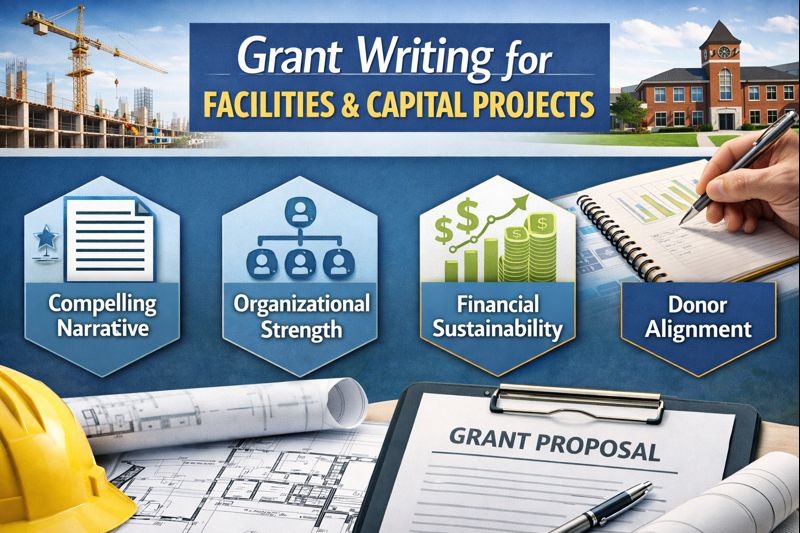
1. Start With a Compelling Capital Narrative
Before writing a single proposal, you must articulate a clear story:
- Why this facility is needed now
- What gap it fills in the community
- Who benefits—and at what scale
- What happens if it is not built
This narrative becomes the foundation for all grant submissions.
2. Build a Donor-Aligned Case for Support
Every capital funder has different motivations:
- Governments focus on compliance, outcomes, and public benefit
- Foundations focus on mission alignment and sustainability
- Corporations look for visibility, workforce, or community impact
- International donors emphasize resilience, equity, and systems change
High-performing organizations tailor language, structure, and tone to each donor—without rewriting from scratch every time.
3. Demonstrate Long-Term Financial Sustainability
Facilities grants live or die on sustainability.
Your proposals must clearly explain:
- Operating budgets post-construction
- Maintenance and lifecycle costs
- Revenue streams or funding commitments
- Risk mitigation strategies
Funders want confidence that their investment won’t become a liability.
4. Prove Organizational Readiness
Capital funders assess you as much as the project.
Strong proposals highlight:
- Governance strength
- Leadership experience
- Past capital or infrastructure success
- Financial controls and transparency
- Partnerships and endorsements
This is about institutional credibility—not just vision.
Why Scale Matters More Than Perfection
One of the biggest misconceptions in capital grant writing is that one perfect proposal will unlock funding.
In reality, success follows the law of averages.
Organizations that win major capital funding typically:
- Submit many donor-aligned proposals
- Apply across multiple funding categories
- Maintain consistent messaging at scale
- Learn and iterate quickly
The challenge?
Most nonprofits lack the internal capacity to produce that volume manually.
How Modern Nonprofits Are Scaling Capital Grant Writing
Increasingly, organizations are adopting AI-supported systems to support—not replace—human expertise.
Platforms like GrantWriterAI are designed specifically for high-volume, donor-aligned grant production, making them particularly effective for capital and facilities funding.
Used strategically, this approach allows nonprofits to:
- Produce 3×–10× more donor-ready proposals
- Reduce reliance on expensive consultants
- Maintain consistent capital narratives across funders
- Mirror donor tone for government, foundation, and international grants
- Empower staff, interns, and volunteers to contribute meaningfully
This shift doesn’t eliminate strategy—it amplifies it.
Capital Projects Are Infrastructure—Your Grant System Should Be Too
Facilities funding is not transactional. It’s infrastructural.
That means your grant-writing approach must also be built as infrastructure:
- Repeatable
- Scalable
- Donor-aligned
- Sustainable for your team
Organizations that treat capital grant writing as a one-time effort often stall. Those that build systems win momentum—and funding.
Key Takeaways
- Grant writing for facilities and capital projects is fundamentally different from program grants
- Big builds require big money, which means multiple funders and high proposal volume
- Donor alignment and sustainability narratives are non-negotiable
- Burnout limits success more than lack of opportunity
- Scalable systems—not heroic effort—drive capital funding wins
Facilities shape futures. But funding them shouldn’t exhaust your team or limit your ambition.
When you’re ready to increase proposal volume, reduce writing costs, and align with donor expectations at scale, explore GrantWriterAI and start free—so your next big build has the funding strategy it deserves.
Build a Stronger Case for Your Capital Funding Needs
A capital grant proposal needs to answer a bigger question than, “What does our organization want to buy or build?”
It needs to explain why the investment is necessary.
Show the funder the problem the project addresses, who will benefit, how the facility or asset will improve your work, what the project will realistically cost, and how your organization will manage and sustain it.
For example, don’t stop at “we need a larger training center.” Explain what limitation the current facility creates, how the proposed improvement responds to that problem, and what realistic difference the investment could make for your programs and beneficiaries.
Prepare your supporting information early. Depending on the funder’s requirements, this may include budgets, quotations, project plans, timelines, ownership or permission documents, organizational records, and information about other funding committed to the project.
🔥 Found a capital funding opportunity and ready to develop your proposal?
Try GrantsWriterAI as a grant-writing assistant to help structure your application, develop key proposal sections, improve donor alignment, and create a repeatable writing workflow. Always verify costs, supporting documents, and the funder’s official requirements before submitting.
📩 Still searching for facilities, equipment, construction, or other capital funding opportunities?
Join Africads Daily Grant Opportunities to discover grants and calls for proposals you can evaluate for eligibility, geography, permitted expenses, organizational requirements, and funding priorities.
A funder is not simply investing in a building, renovation, vehicle, or piece of equipment. Your proposal needs to show how that capital investment will strengthen your organization’s ability to deliver its mission and create meaningful value for the people you serve.
Frequently Asked Questions (FAQs)
1. What is grant writing for facilities and capital projects?
It involves securing funding for buildings, renovations, land acquisition, and infrastructure rather than ongoing programs or services.
2. How long do capital grants usually take to secure?
Capital grants often take 6–24 months from application to award due to larger sums and deeper due diligence.
3. Can small nonprofits apply for capital grants?
Yes, but they must demonstrate strong governance, partnerships, and sustainability to offset perceived risk.
4. How many grants should we apply for in a capital campaign?
There is no fixed number, but successful campaigns often involve dozens of submissions across funder types.
5. Do capital grants require matching funds?
Many do. Funders often want proof that other donors are already committed.
6. What documents are commonly required?
Architectural plans, budgets, timelines, financial statements, and board approvals are often required.
7. Are government grants good for facilities projects?
Yes. Government funders frequently support infrastructure, especially for health, education, and community development.
8. How important is sustainability in capital grant proposals?
Critical. Funders want assurance the facility can be maintained long after construction ends.
9. Can AI really help with capital grant writing?
Yes—when used responsibly. AI can scale drafting, donor alignment, and structure while humans guide strategy and oversight.
10. What’s the biggest mistake nonprofits make with capital grants?
Applying to too few funders due to capacity limits—dramatically reducing their chances of success.


