
Have you ever dreamed of starting a church but felt overwhelmed by the legal and financial obstacles?
Many pastors and ministry leaders face questions about registration, donor requirements, financial controls and organizational capacity when launching a new project. Fiscal sponsorship may be one option, but it should be evaluated alongside the legal and operational requirements that still apply to the church or project.
Fiscal sponsorship may be one possible structure for a new ministry or charitable project, but it should be evaluated against the project’s legal status, funding sources, operational needs and the sponsor’s written agreement.
Evidence note: Case studies described as “real examples” should be independently verifiable. Africads is reviewing the named examples in this article; until verification is complete, do not treat an example below as an Africads-verified case study or as proof of typical results.
In this article, you’ll explore illustrative church fiscal-sponsorship scenarios, how different sponsorship structures work, and the questions ministries should verify before relying on a sponsor for grants, donations or administration.
Also Read: What is fiscal sponsorship for churches? If your ministry is exploring this pathway, Africads Fiscal Sponsorship Services can help you prepare the project, documentation and sponsor questions.
A Detailed Explanation of Churches Starting Under Fiscal Sponsorship
What Is Fiscal Sponsorship?

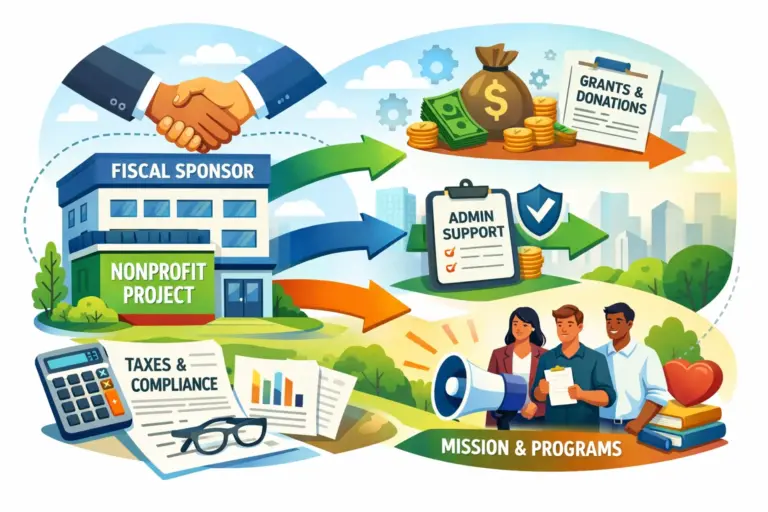
Fiscal sponsorship is a structured relationship in which a nonprofit sponsor provides defined fiduciary oversight, financial management and administrative support for charitable work. In U.S. practice, a comprehensive sponsorship can make the project a program of the sponsor, while a pre-approved grant relationship leaves the project legally separate and subject to grant oversight.
This does not automatically remove local registration, tax, banking, employment or regulatory obligations. The actual responsibilities depend on the sponsorship model, written agreement, donor rules and the law that applies in the project’s jurisdiction.
Why It’s Popular Among New Churches
Churches that feel called to start community work, worship gatherings, or outreach programs often don’t have the legal team, funding, or time to register immediately.
Depending on the model and sponsor, fiscal sponsorship may provide:
- Additional financial and administrative oversight
- A potential pathway for eligible charitable donations or grants where the sponsor and donor rules permit it
- Administrative and compliance support
- Focus on ministry rather than paperwork
Different Models of Fiscal Sponsorship
There are two main types:
- Model A – Direct Project: The sponsor takes control of the project.
- Model C – Grantor-Grantee Relationship: The project remains independent but receives funds through the sponsor.
Model C may preserve greater organizational separation in U.S. practice, but it is not automatically preferable for churches. The right structure depends on legal status, administrative capacity, donor requirements, risk, fund control and the sponsor’s written agreement.
How It Works in Africa and Globally
Organizations in Kenya, Nigeria, Ghana and other African jurisdictions may use partnerships, grant-hosting or sponsorship-like arrangements, but the terminology and legal effect are not uniform. Each organization should verify the local legal, tax, banking and donor framework that applies.
Depending on the arrangement, a partner organization may support functions such as:
- Administrative and financial oversight
- Receiving or administering eligible grant funds where donor rules permit
- Launch community projects
- Reporting, due diligence and documentation support
The scenarios below are educational examples, not verified stories of success.
Illustrative Church Fiscal Sponsorship Scenarios
Important: The scenarios below are for planning and education. Africads could not independently verify the previously named stories to a standard suitable for publication as factual case studies, so they should not be treated as documented client or church outcomes.
1. Illustrative Scenario: A New Church Plant in Kenya
Scenario: A new church plant is considering working with a registered nonprofit to strengthen administration and donor accountability while it develops its own systems.
The church should first verify its Kenyan registration, tax, banking and operational obligations and then determine whether the proposed sponsor arrangement is accepted by the intended donor.
Before entering a sponsorship arrangement, the church should clarify:
- Which entity will sign donor and grant agreements.
- Who will receive, control and report on restricted funds.
- Which local legal and regulatory obligations remain with the church.
- What happens to funds, assets and donor records if the relationship ends.
This is an illustrative scenario, not a documented Africads client case study.
2. Illustrative Scenario: A South African Ministry Needs Administrative Support
Scenario: A ministry team wants support with financial administration, governance and donor reporting while retaining clarity about which responsibilities remain with its own organization.
The ministry should verify its South African legal and tax obligations and define exactly which administrative functions a proposed sponsor would perform.
Before signing an agreement, the ministry should clarify:
- Legally run their services
- Set up mobile donation platforms
- Train their volunteers in compliance and governance
This is an illustrative scenario, not a documented Africads client case study.
3. Illustrative Scenario: A Nigerian Ministry Receives Overseas Support

Scenario: A Nigerian ministry is exploring overseas funding through a foreign sponsor. It must verify cross-border grant, banking, reporting, tax and donor requirements before assuming the arrangement is workable.
This ministry started with crusades and prayer meetings in Lagos. The founders didn’t want to delay momentum with lengthy nonprofit paperwork.
For an overseas-funding arrangement, the ministry would need to verify:
- Whether the donor and sponsor permit grants to the ministry and what due diligence is required
- How restricted funds, programme expenditure and reporting will be managed
- What local registration, banking and tax obligations remain with the ministry
This is an illustrative scenario, not a documented quotation or Africads client case study.
4. Illustrative Scenario: A Ghanaian Church Launches a Community Programme
Scenario: A church wants to add a health or community programme and is considering whether a sponsor could provide suitable financial oversight and grant administration.
In the rural communities of Kumasi, Pastor Emeka wanted to start a church and health outreach.
For a church-community programme arrangement, the parties should clarify:
- Which entity is legally responsible for the programme and any regulated activities
- How partner, donor and safeguarding responsibilities are allocated
- How programme funds, reporting and operational decisions will be controlled
This is an illustrative scenario, not a documented Africads client case study or verified impact result.
5. Illustrative Scenario: A U.S. Church Project Plans for Independence
Scenario: A U.S.-based charitable church project begins under a fiscal sponsor and plans from the outset for a possible later transition to its own long-term structure.
This church started in the Bronx, New York. Instead of registering immediately, they focused on launching their ministry.
The fiscal sponsor handled:
- All IRS compliance
- Bookkeeping and donation tracking
- Grant applications
A project planning for independence should address transfer of assets, restricted funds, contracts, donor records and outstanding liabilities in its written agreement.
Benefits Churches Gained Through Fiscal Sponsorship
Speed to Launch
Administrative support can sometimes help a project begin charitable work sooner, but timing varies by sponsor, agreement and local legal requirements. Fiscal sponsorship should not be presented as a guaranteed shortcut around registration.
Donor Confidence
Sponsors provided trust and systems that helped new churches raise more support.
Legal Protection
A well-structured sponsorship can strengthen oversight and risk management, but it does not automatically make every church activity legally compliant. Responsibilities must be identified in the agreement and under applicable law.
Admin Support
From taxes to bank accounts to grant writing—churches were backed by experts.
Time to Focus on Ministry
Leaders focused on preaching, outreach, and discipleship—while paperwork was handled.

How Africads Consultants Helps Churches Launch with Fiscal Sponsorship
Africads Consultants partners with churches and ministries across Africa and beyond to:
- Connect churches with government-registered fiscal sponsors
- Help set up legal, tax-compliant giving systems
- Offer mentorship in transitioning to full nonprofit registration
- Support with digital outreach, including SEO, Google Ads, and donor engagement
- Train pastors through courses in nonprofit management, Google Grant Ads, volunteer management, and more
Africads provides fiscal sponsorship guidance, readiness support and practical preparation for churches and nonprofit teams. Specific client outcomes should only be published as case studies when the underlying engagement and results can be documented.
Whether you’re starting or scaling, Africads can help your team understand fiscal sponsorship, prepare documentation and evaluate the questions to ask potential sponsors. Africads is not itself a fiscal sponsor.
Final Thought
Starting a church can involve significant legal, financial and fundraising decisions. Fiscal sponsorship may be one structure worth evaluating, but its suitability depends on the sponsor, the project, the donor and the applicable jurisdiction.
The scenarios above show the kinds of questions churches in different jurisdictions may need to work through. They do not demonstrate typical outcomes or guarantee that fiscal sponsorship will be available or appropriate.
If your ministry is considering fiscal sponsorship, use these scenarios to identify the legal, financial, donor and governance questions that need answers before entering an agreement.
FAQs About Churches Starting Under Fiscal Sponsorship
1. Can any church qualify for fiscal sponsorship?
Yes, as long as your mission aligns with the sponsor’s nonprofit goals and you meet their requirements.
2. Is fiscal sponsorship a permanent arrangement?
No. Most churches use it temporarily before registering their own nonprofit.
3. Do I lose control of my church under a sponsor?
Not usually. Under Model C sponsorships, you retain program control but must meet sponsor guidelines.
4. How are donations handled?
The sponsor receives donations and disburses them to your church as per the agreement.
5. Do I need to be registered with the government?
It depends on the country, activity and sponsorship model. A sponsor does not automatically remove local registration or regulatory obligations.
6. Can I receive international donations under fiscal sponsorship?
Yes. That’s one of the major benefits—many sponsors are legally allowed to receive global donations.
7. How long can I stay under fiscal sponsorship?
It depends. Some stay for 1–3 years; others longer depending on growth and resources.
8. Are there fees for fiscal sponsorship?
Yes, typically between 5–15% of incoming donations. But it’s far less than setting up your own admin structure.
9. Can fiscal sponsorship work in Africa?
Sponsorship-like arrangements may be possible, but terminology, legal structure and tax treatment vary by country. Verify the local framework and the proposed sponsor’s authority before relying on the arrangement.
10. Can Africads Consultants help us prepare for fiscal sponsorship?
Yes. Africads provides guidance, readiness and preparation support. We do not present Africads itself as a fiscal sponsor, and sponsor fit and availability must be verified case by case.
Ready to Launch Your Church Under Fiscal Sponsorship?
At Africads Consultants, we help churches understand fiscal sponsorship, assess readiness, prepare documentation and develop the questions they should ask before entering a sponsorship arrangement.
Whether you’re in Kenya or elsewhere, we can help you prepare for sponsor conversations and strengthen donor-readiness systems. Sponsor availability, eligibility and legal suitability must be verified for each organization and jurisdiction.
👉 Book a FREE 30-minute strategy call with our team today and find out how your church can start strong under fiscal sponsorship.
👉 Click Explore fiscal sponsorship servicesto get matched with a fiscal sponsor now.
Don’t let legal hurdles delay your calling. Let’s build the church you’ve envisioned — together.
Conclusion
These scenarios illustrate how church fiscal sponsorship can work; they are not verified client case studies or guaranteed results. The useful lesson is to match the sponsor model to the ministry’s funding, governance and reporting needs, then put the responsibilities in writing before accepting donations.
Put this guide into practice
Free resource: Fiscal Sponsorship Agreement Template. Use the agreement template to structure a discussion with your fiscal sponsor and adapt it to your arrangement.
Optional paid resource: Fiscal Sponsorship Toolkit. Practical documents for fiscally sponsored projects, nonprofit founders and fiscal sponsors. Review the product details and current price before purchasing.